







Degrees Of Freedom / And.Id - E.G. Intensity / The Travellers FLAC
Tracklist
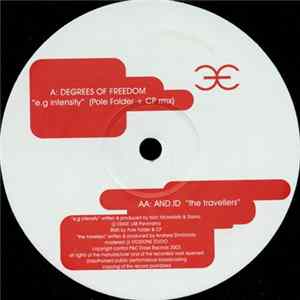
| 1 | –Degrees Of Freedom | E.G. Intensity (Pole Folder & CP Remix)Arranged By – CP, Pole FolderRemix – Pole Folder & CPWritten-By, Producer – Nicolas "Proteus" Michailidis, Stama |
| 2 | –And.Id | The TravellersWritten-By, Producer – Andreas Dimitriadis |
Video
Album
In statistics, the number of degrees of freedom is the number of values in the final calculation of a statistic that are free to vary. The number of independent ways by which a dynamic system can move, without violating any constraint imposed on it, is called number of degrees of freedom. In other words, the number of degrees of freedom can be defined as the minimum number of independent coordinates that can specify the position of the system completely. Degrees Of Freedom, - E. Intensity, The Travellers Label:Erase Records Catalog:ER001 Format:Vinyl, 12 Country:Greece Released:20 Nov 2003 Genre:Electronic Style:Progressive House, Progressive Trance info: Категория. And other albums from DEGREES OF FREEDOM are available on sale at Recordsale. Intensity, The Travellers. items in stock. Cover, Media grading. Generic, VG. Degrees Of Freedom, . Intensity, The Travellers 12. Erase Records. ER001. ER191. Jazzylicious - The Debut Album 12xFile. Because degrees of freedom are generally not something you need to understand to perform a statistical analysis-unless youre a research statistician, or someone studying statistical theory. And yet, enquiring minds want to know. So for the adventurous and the curious, here are some examples that provide a basic gist of their meaning in statistics. The Freedom to Vary. First, forget about statistics. The number of degrees of freedom is a measure of how many values can vary in a statistical calculation while still working within a given formula. Courtney K. Taylor, Ph. is a professor of mathematics at Anderson University and the author of An Introduction to Abstract Algebra. Courtney Taylor. Updated December 31, 2018. In statistics, the degrees of freedom are used to define the number of independent quantities that can be assigned to a statistical distribution. This number typically refers to a positive whole number that indicates the lack of restrictions on a person's ability to calculate missing factors from statistical problems. For example: number of degrees of freedom for a coin tossed would be 1 because total outcomes after a coin has been tossed van be either a head or a tail i. a total of n 2 outcomes. so, d. However, tossing 10 coins and finding that all 10 land the same way up would be considered an extreme result: for fair coins the probability of having the first coin matched by all 9 others is 199 , which is rare. The result may therefore be considered statistically significant evidence that the coins are not fair. Поиск презентаций, докладов, научных статей, публикаций и других образовательных материалов по запросу album Degrees Of Freedom, E. Degrees of freedom DF indicate the number of independent values that can vary in an analysis without breaking any constraints. It plays an essential role throughout statistics. Learn how this fundamental concept affects the power and precision of your analysis. It is usually a positive whole number. Degrees of freedom is a combination of how much data you have and how many parameters you need to estimate. It indicates how much independent information goes into a parameter estimate. In this vein, its easy to see that you want a lot of information to go into parameter estimates to obtain more precise estimates and more powerful hypothesis tests. Degrees of freedom, often abbreviated df, is a concept that may be thought of as that part of the sample size n not otherwise allocated. This concept relates to quite a number of aspects of statistical methods thus, df may be explained in a number of ways. For instance, the overall level of the immune response of the body to an infection the quantities that describe the intensity of the breath resulting multipart to some extent factor spaces representing the linear and nonlinear combinations of parameters measured in biochemistry the extent of enzyme isomerization. Many more examples could be used. Actually, Degrees of freedom df is an abstract and difficult statistical concept. Many elementary statistics textbook introduces this concept in terms of the number that are free to vary Howell, 1992 Jaccard & Becker, 1990. Some statistics textbooks just give the df of various distributions e. Moore & McCabe, 1989 Agresti & Finlay, 1986. Even advanced statistics textbooks do not discuss degrees of freedom in detail e. Hays, 1981 Maxwell and Delany, 1986 Winner, 1985. It is not uncommon that many advanced statistics students and experienced researchers have a vague idea of degrees of freedom