Fauré, Victoria De Los Angeles, Dietrich Fischer-Dieskau, The Paris Conservatoire Orchestra, André Cluytens
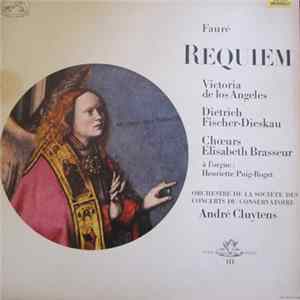
Fauré, Victoria De Los Angeles, Dietrich Fischer-Dieskau, The Paris Conservatoire Orchestra, André Cluytens - Requiem, Op.48 (LP, Gat)
His Master's Voice
SAN 107
UK
1963
SAN 107
Fauré, Victoria De Los Angeles, Dietrich Fischer-Dieskau, The Paris Conservatoire Orchestra, André Cluytens
Fauré, Victoria De Los Angeles, Dietrich Fischer-Dieskau, The Paris Conservatoire Orchestra, André Cluytens - Requiem, Op.48 (LP)
His Master's Voice
SAN 107
UK
1963
ESSE-90055
Fauré, Victoria De Los Angeles, Dietrich Fischer-Dieskau, Orchestre De La Société Des Concerts Du Conservatoire, André Cluytens
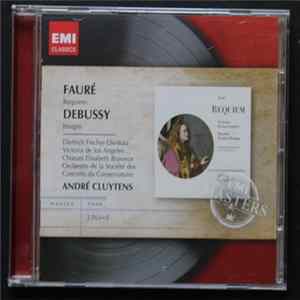
Fauré, Victoria De Los Angeles, Dietrich Fischer-Dieskau, Orchestre De La Société Des Concerts Du Conservatoire, André Cluytens - Requiem, Op.48 (SACD, Hybrid, Album, Ltd, RE, RM)
Esoteric Company, EMI Classics
ESSE-90055
Japan
2011
35974
Gabriel Fauré - André Cluytens, Orchestre De La Société Des Concerts Du Conservatoire, Victoria De Los Angeles, Dietrich Fischer-Dieskau
Gabriel Fauré - André Cluytens, Orchestre De La Société Des Concerts Du Conservatoire, Victoria De Los Angeles, Dietrich Fischer-Dieskau - Requiem (LP, Album, Mono)
Angel Records
35974
Canada
Unknown
037 1006321
Fauré, Victoria De Los Angeles, Dietrich Fischer-Dieskau, Orchestre De La Société Des Concerts Du Conservatoire, André Cluytens
Fauré, Victoria De Los Angeles, Dietrich Fischer-Dieskau, Orchestre De La Société Des Concerts Du Conservatoire, André Cluytens - Requiem (LP, RE)
EMI
037 1006321
Spain
1985
Credits
Baritone Vocals – Dietrich Fischer-Dieskau (tracks: A2)
Directed By – André Cluytens
Orchestra – Orchestre De La Société Des Concerts Du Conservatoire
Organ – Henriette Puig-Roget
Soprano Vocals – Victoria De Los Angeles (tracks: B1)
Barcodes
Matrix / Runout: 2YLA 1148
Matrix / Runout: 2YLA 1149
Video
Album
Gabriel Fauré composed his Requiem in D minor, Op. 48, between 1887 and 1890. The choral-orchestral setting of the shortened Catholic Mass for the Dead in Latin is the best-known of his large works. Its focus is on eternal rest and consolation. Fauré's reasons for composing the work are unclear, but do not appear to have had anything to do with the death of his parents in the mid-1880s. He composed the work in the late 1880s and revised it in the 1890s, finishing it in 1900. Альбом 2006 Пісень: 17. Спробуйте безкоштовно. Fauré: Requiem. Artists: New York Philharmonic, Nadia Boulanger. Requiem, Op. Introitus and KyrieLive. Vernon de Tar, Faure. Gabriel Fauré - Faure: Requiem, Op. Introit & Kyrie. Pie Jesu. Agnus Dei. Similar compilations. Gabriel Fauré. Requiem - Pelléas Et Mélisande - Pavane. Classical Music. Giuseppe Verdi, Gabriel Fauré. Tresors Des Requiem. CD3. Listen free to Gabriel Fauré Fauré Requiem Requiem in D Minor, Op. Gabriel Urbain Fauré 12 May 1845 4 November 1924 was a French composer, often seen as a transitional figure between the Romantic period and Impressionism. In contrast with his harmonicListen free to Gabriel Fauré Fauré Requiem Requiem in D Minor, Op. 48: Introit et Kyrie, Requiem in D Minor, Op. 48: Offertoire and more. 20 tracks 65:25. In contrast with his harmonic read more. In contrast with his harmonic and melodic style, which pushed the bounds fo read more. Composer: Gabriel Urbain Fauré 12 May 1845 - 4 November 1924 - Performers: The Cambridge Singers, Members of the City of London Sinfonia, John , Pavane, Elegie, Apre un reve, Dolly. 1 - Fauré: Requiem, Op. 48 - Introït Et Kyrie. 2 - Fauré: Requiem, Op. 48 - Offertoire. 3 - Fauré: Requiem, Op. 48 - Sanctus. 4 - Fauré: Requiem, Op. 48 - Pie Jesu. 5 - Fauré: Requiem, Op. 48 - Agnus Dei. 6 - Fauré: Requiem, Op. 48 - Libera Me. 7 - Fauré: Requiem, Op. 48 - In Paradisum. Gabriel Fauré, Kathleen Battle, Andreas Schmidt, Philharmonia Orchestra, Carlo Maria Giulini. urn:mb releasegroup id:19d5ecc4-8936-49e5-bfb3-41f78e990516 urn:mb release id:f89438a9-2769-4b85-b3dc-e87cb2171fb8 urn:upc:028947456223. In his seven-section Requiem, the French composer Gabriel Fauré distilled some of the most beautiful melodies he ever composed. The creation was almost certainly a musical tribute to his father, who died in 1885, three years before work on the Requiem began. As with much of Western classical music, the Requiem owes its roots to Christian faith. Traditionally, at its heart, it is a prayerful lament for the dead. Faurés Requiem was altogether different, though, because here was a composer who, unlike many of his contemporaries, had no clear religious beliefs. By contrast, he was very much a dou. More by Gabriel Fauré. Fauré: Complete Nocturnes. 1997 New York Philharmonic