







Tracklist
| 1 | Untitled |
| 2 | Untitled |
Versions
| Category | Artist | Title (Format) | Label | Category | Country | Year |
|---|---|---|---|---|---|---|
| ZCR 466 | Mahatma Gandhi | His Life And Philosophy (Cass, Mono) | BBC | ZCR 466 | UK | 1983 |
Credits
- Narrator – Francis Watson
- Producer – Sylvia Cartner
Notes
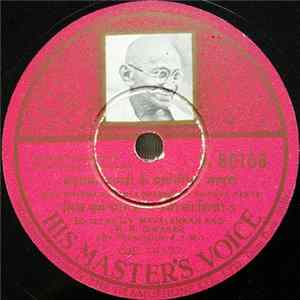
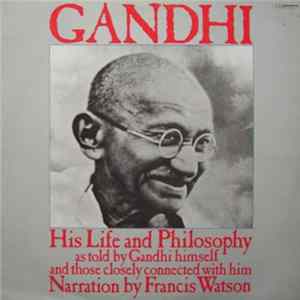
His Life and Philosophy as told by Gandhi himself and those closely connected with him. Narration by Francis Watson.
Recordings from the BBC Sound Archives of Mahatma Gandhi and those connected with his remarkable life and work. Narration written and spoken by Francis Watson. Includes the voices of Mahatma Gandhi, Jawaharlal Nehru, Dr. Zakir Husain, The 1st Earl of Halifax (Lord Irwin), Earl Mountbatten of Burma, Sir Robert Broomfield, Chakravarti Rajagopalachari, Rajkumari Amrit Kaur, Dr. Gilbert Murray, O.M., Acharya J.B. Kripalani , Raja Hutheesingh, H. S. L. Polak, Pyarelal Nayar, Dr. Sushila Nayar, Dr. B. R. Ambedkar, Mirabehn (Mirabehn), Reginald Reynolds, Maurice Frydman, G. D. Birla, Shankerlal Banker, P. L. O'T Quinn, H. N. Brailsford, Sudhir Datta, Muriel Lester, Brijkrishna Chandiwala, K. Shridharani, Robert Stimson, J. R. Glorney Bolton and Sudhir Ghosh.
Actuality recordings include the moment of Independence for India on August 15th, 1947 with crowds shouting “Mahatma Gandhi ki jay”; A message from Gandhi to the West just after Independence; Three excerpts from Gandhi speaking in English at the Asian Relations Conference in New Delhi, April 2nd, 1947; a bomb going off while Gandhi is speaking in his own language at his prayer meeting; Gandhi speaking about the people of East London where he was staying in 1931.
Music is traditional Indian (BBC Copyright) and includes a recording of a beggar in a train playing a Bulbultarang (keyboard zither).
The life of Mohandas Karamchand Gandhi — Mahatma Gandhi to the multitude — was regarded by himself as one of continual experiment. His formative years in South Africa gave him a personal direction, and the chance to test his principles and his techniques of non-violence with spectacular — if temporary — success against the specific injustices ofdiscriminatory legislation. His subsequent revolutionary role in India, beginning in the same way with a protest against particular laws (enacted as a matter of emergency in the aftermath of World War I) carried him to the leadership of a movement, which already existed, for a political independence which was already envisaged. The things that mattered deeply to Gandhi were the means by which independence should be attained, and the sort of India that it should produce. But right up to the political goal, and beyond it to the assassination that ended his long life, the process was still experimental. One of his favourite English hymns was Lead, Kindly Light, and its most-quoted line was 'One step enough for me: He called his vivid fragment of autobiography Experiments with Truth. And his wide-ranging political and social activity had spiritual fulfilment as its goal rather than its origin.
Throughout his extraordinary career, while he felt himself to be at every moment on trial by God, Gandhi exposed himself, his ideas and his actions to the tribunal of his fellow-men. Entirely human and devastatingly charming in his personal relations, he was on trial by his closest colleagues as well as by his political rivals, by the British opponents whom he strove to convince rather than to defeat, and in the widening court of world opinion. "I have not known any man of that greatness;' says the President of India, Dr. Zakir Husain, in his recording, "who could tolerate opposition as much as he did, and who welcomed discussion as much as he did."
With this as a leitmotiv, and with more than 25 hours of recorded speech about Gandhi from which to select, the intention has been to form a pattern of intimate and informal testimony, presenting Gandhi as eye-witnesses saw him at some of the high-points of his astonishing career: the early triumphs in South Africa; the almost legendary 'Great Trial' in Ahmedabad in 1922 — after which, though Gandhi was imprisoned half-a-dozen times by the authorities in India, he was never again produced in court; the Salt March that opened his second mass- campaign in 1930 and the yet more historic meetings with Lord Irwin (afterwards Lord Halifax) that brought it to an end with what Winston Churchill called 'the nauseating spectacle of a seditious fakir.walking half naked up the steps of the Viceroy's palace, there to parley and negotiate with the representative of the King- Emperor'; the visit to England in 1931; the "Epic Fast" for the Untouchables; the "Quit India" demand during World War II and the last confinement that followed it; the lonely struggle against spreading violence that some have called Gandhi's finest hour; and the final sacrifice, not unexpected by its victim, murdered by one of his own people at his Delhi prayer-meeting.
Francis Watson
Barcodes
- Matrix / Runout (Side A): REH 466 A
- Matrix / Runout (Side B): REH 466 B
Companies
- Distributed By – PRT Records Ltd.
Video
Album
Gandhism is a body of ideas that describes the inspiration, vision, and the life work of Mohandas Gandhi. It is particularly associated with his contributions to the idea of nonviolent resistance, sometimes also called civil resistance. The two pillars of Gandhism are truth and nonviolence. The term Gandhism also encompasses what Gandhi's ideas, words, and actions mean to people around the world and how they used them for guidance in building their own future. Gandhism also permeates into the realm. Books: Gandhi: A Life by Yogesh Chadha Wiley, 1998 Gandhi: Prisoner of Hope by Judith M. Brown 1989. Louis Fischer wrote an authoritative biography about Gandhi. Gandhi's Early Life and Family. Gandhi went to England to discover the cradle of civilization and was instead awakened to his Indian roots. Gandhi was trained as a lawyer in England. He became quite Westernized and sophisticated. गध-दरशन: The Gandhi Philosophy. महतम गध जवन और दरशन: Mahatma Gandhi His Life and Philosophy. Код товара: NZP199. Gandhian Philosophy in Short. I know the path. It is straight and narrow. It is like the edge of a sword. I rejoice to walk on it. Whatever striking things I have done in life, I have not done prompted by reason but prompted by instinct, I would say, . I am a man of faith. My reliance is solely on God. A man can as little discard such leadership as he can the color of his skin. And since I have become an integral part of the nation, it has to keep me with all my faults and shortcomings, of some of which I am painfully conscious and of many others of which candid critics, thanks be to them, never fail to remind . It is a bad carpenter who quarrels with his tools. Today, it has become very important that people re-think and consider Gandhijis teachings. There is lot of violence seen in the world and the principles of Gandhiji are needed throughout the world. Do you want to know some interesting facts about Mahatma Gandhi's life, work and philosophy On the occasion of the birth anniversary of the father of our nation, let's open some pages of his life and try to imbibe what he used to preach and practice. Read on to know more about life, work and philosophy of Mahatma Gandhi. It presents his life, parentage, and childhood in order to discuss the formative phases of his early life, which helped shape his public life later. Author B. Sharma explores his efforts at establishing Ashrams, which were the training institutes to prepare Satyagrahis. The author shows Gandhi as This book is an attempt to comprehend Mahatma Gandhi's philosophy and life. Sharma explores his efforts at establishing Ashrams, which. Vows he made throughout his life: Ahimsa: Nonviolence Satya: Truth Asteya: Non-Stealing Brahmacharya: Self Discipline Aparigraha: Non-Possession Sharirshrama: Bread Labor Aswada: Control of the Palate Sarvatra Bhayavarjana: Fearlessness Sarva Dharma Samantva: Equality of All Religions Swadeshi: Use Locally Made Goods Sparshbhavana: Remove Untouchability. Once Gandhi made a vow he never broke it. mahatma gandhi story in english gandhi documentary in english gandhi philosophy of life worry less what other people think gandhi. Gandhi's life and message can be a life-changing experience for one willing to think about his search for Truth, and his unwillingness to compromise even in the face of seemingly insurmountable opposition. When I decided to read up on Ghandi's life, I was confronted with many many volumes. I didn't know which to choose, so I bought several, in hopes that at least one would be a good choice. I needn't have worried. This particular volume is small and thin, and I selected it in part because of its size - a thicker volume on a man I knew nothing about would have been too intim. The life of the lawyer who became the famed leader of the Indian revolts against the British rule through his philosophy of nonviolent protest. Added to Watchlist. Saeed Jaffrey, Roshan Seth, and Alyque Padamsee do well as Gandhi's pro-independence collaborators. Ditto, Athol Fugard Assuming we are in agreement and John Gielgud Salt as two of his adversaries. Charleson, in his clerical collar, looks like he has walked in off the set of the preceding year's Academy Award winner, Chariots of Fire where he played the Scottish sprinter-missionary, Eric Liddell. This movie won eight Oscars, with Attenborough, Briley, and Kingsley all earning honors. This essay takes you through his life history, including his philosophy of Satyagraha, non-cooperation, assassination etc. Mohandas Karamchand Gandhi was an eminent freedom activist and an influential political leader who played a dominant role in India's struggle for independence. Gandhi is known by different names, such as Mahatma a great soul, Bapuji endearment for father in Gujarati and Father of the Nation. Every year, his birthday is celebrated as Gandhi Jayanti, a national holiday in India, and also observed as the International Day of Nonviolence