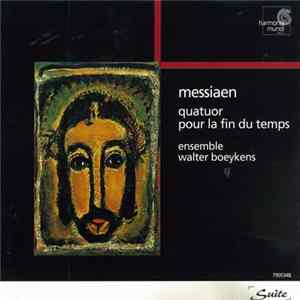



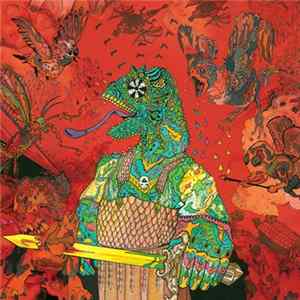


Olivier Messiaen - Quatuor Pour La Fin Du Temps FLAC

Tracklist
| 1 | Danse De La Fureur, Pour Les Sept Trompettes |
| 2 | Vocalise, Pour L'Ange Qui Annonce La Fin Du Temps |
| 3 | Louange À L'Eternité De Jésus |
| 4 | Liturgie De Cristal |
| 5 | Fouillis D'Arcs-En-Ciel, Pour L'Ange Qui Annonce La Fin Du Temps |
| 6 | Louange À L'Immortalité De Jésus |
| 7 | Abîme Des Oiseaux |
| 8 | Intermède |
Credits
- Cello [Violincello] – Albert Tetard
- Clarinet – Claude Desurmont
- Composed By – Olivier Messiaen
- Engineer [Balance] – Klaus Scheibe
- Piano – Daniel Barenboim
- Producer – Günther Breest
- Recorded By [Supervision] – Wolfgang Stengel
- Violin – Luben Yordanoff
Notes
'Quatuor Pour La Fin Du Temps' recorded in the presence of the composer and given his authorization. Paris, Maison de la Mutualité, 4/1978.
Album
Quatuor pour la fin du temps French pronunciation: , also known by its English title Quartet for the End of Time, is a piece of chamber music by the French composer Olivier Messiaen. It was premiered in 1941. The piece is scored for clarinet in B-flat, violin, cello, and piano a typical performance of the complete work lasts about 50 minutes. Messiaen wrote the piece while a prisoner of war in German captivity and it was first performed by his fellow prisoners. It has. Quatuor pour la fin du temps 1941 Pianist: Matthew Schellhorn Soloists of the Philharmonia Orchestra: James Clark violin, Barnaby Robson clarinet. Формируйте собственную коллекцию. The piece was Olivier Messiaens Quartet for the End of Time Quatour pour la Fin du Temps. A fitting title under the dire circumstances perhaps, but its true ideology stems from a much more thought provoking subject. A religious man at heart, Messiaen was indeed never brought up strongly devout, and always claimed his religious state was due to simply being born a believer. Whether we can believe him or not, Messiaen forever maintained that the true meaning of the work was entirely independent of its apparent initial source: war and the end of the time and the world. But the idea of time. Quatuor pour la fin du temps, 'Quartet for the End of Time': Liturgie de cristal - Edward Elgar. Лента с персональными рекомендациями и музыкальными новинками, радио, подборки на любой вкус, удобное управление своей коллекцией. Listen free to Olivier Messiaen Quatuor pour la Fin du Temps Liturgie De Cristal, Vocalise, Pour L'Ange Qui Annonce La Fin Du Temps and more. 8 tracks 46:36. Olivier Messiaen December 10, 1908 April 27, 1992 was a French composer, organist, and ornithologist. Messiaen's music is rhythmically complex he was interested in rhythms from ancient Greece and from Hindu sources, and is harmonically and melodically based on modes of limited transposition, which were Messiaen's own innovation. On connaît la place si particulière du Quatuor pour la fin du temps dans l'œuvre de Messiaen : composée en captivité et créée au Stalag VIIIA le 15 janvier 1941 par d'autres prisonniers et Messiaen lui-même au piano, l'œuvre est selon le compositeur d'un langage musical essentiellement immatériel, spirituel, catholique . Musicologists often revere Olivier Messiaen's 1941 Quatuor pour la fin du Temps Quartet for the End of Time as one of the most, if not the most, important works of the twentieth century. Olivier Messiaen. Yet the reason is often overlooked, even though it lurks in plain sight right there in the title. I'll admit that decades ago I was first drawn to the Quatuor by its potent title. Le Boulaire recalled that although the score was difficult and his demands severe, Messiaen provided constant guidance and reassurance. The camp commandant loved music and obtained instruments, including a violin and piano. Quartet for the End of Time, French Quatuor pour la fin du temps, quartet in eight movements for clarinet, violin, cello, and piano by French composer Olivier Messiaen. The piece premiered on January 15, 1941, at the Stalag VIIIA prisoner-of-war camp, in Görlitz, Germany, where the composer had been confined since his capture in May 1940. Messiaen eschewed the usual tendency of Western music for regular rhythms and metres and instead offered ever-changing, often-unpredictable patterns, frequently based on prime numbers, especially 5, 7, 11, and 13. 1969 Quatuor pour la fin du temps 1940 Daniel Barenboim piano Luben Yordanoff violin Albert Tetard cello Claude Desurmont clarinet. 1978 Piece for Piano and String Quartet Yvonne Loriod piano Rosemonde String Quartet. 1999 Oiseaux exotiques 1956 Jean-Yves Thibaudet piano Royal Concertgebouw OrchestraRiccardo Chailly. Chamber Music. CD 28 2008